Learning Outcome #3
Learning Outcome #3: Employ techniques of active reading, critical reading, and informal reading response for inquiry, learning, and thinking.
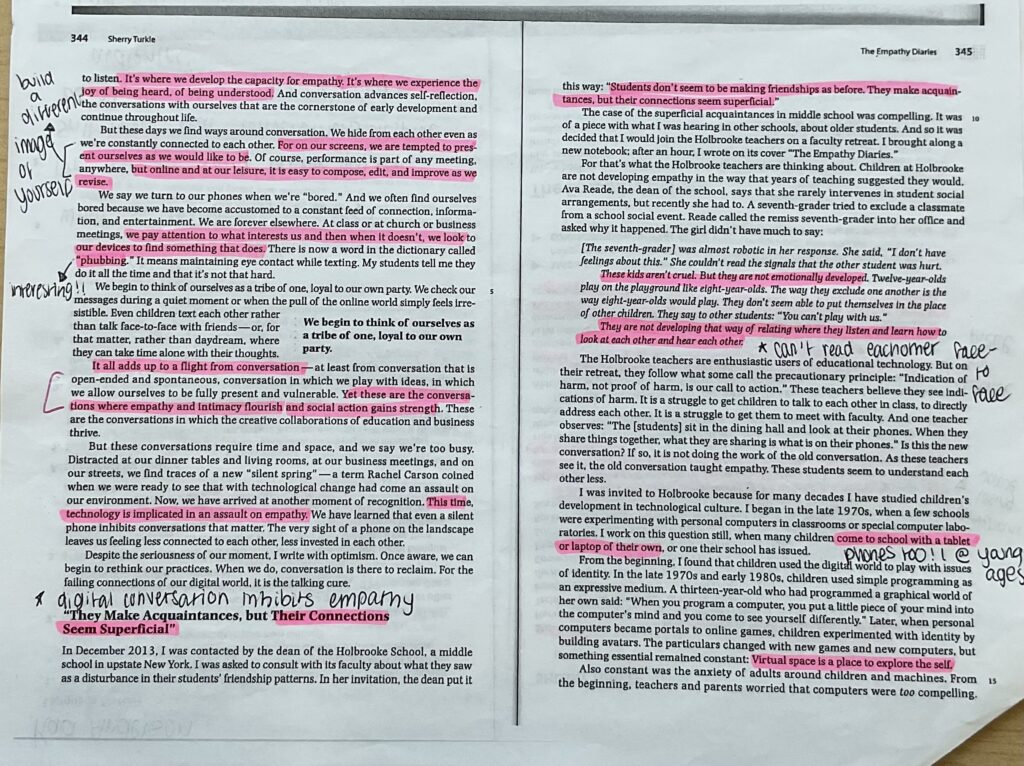
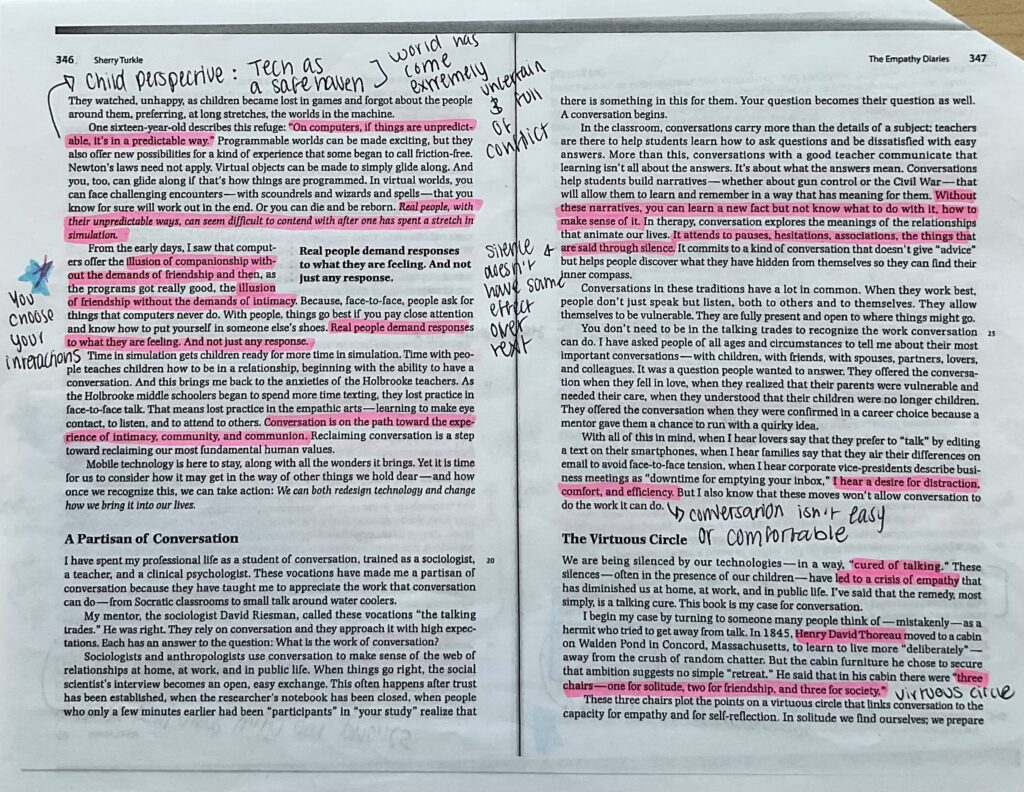
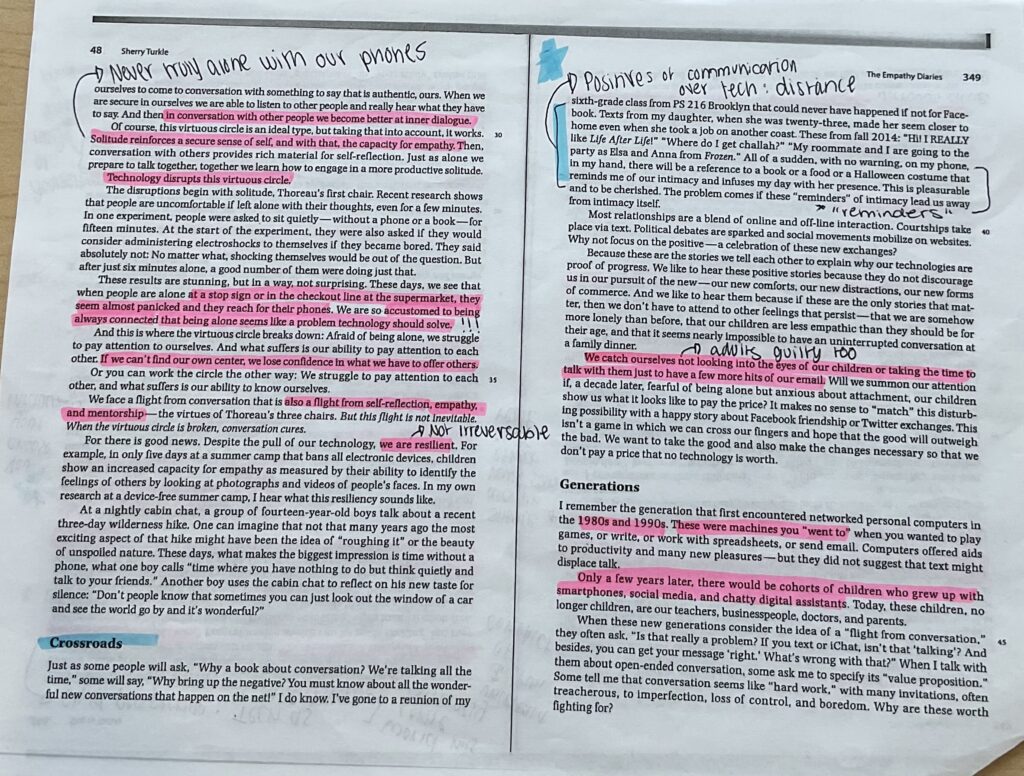
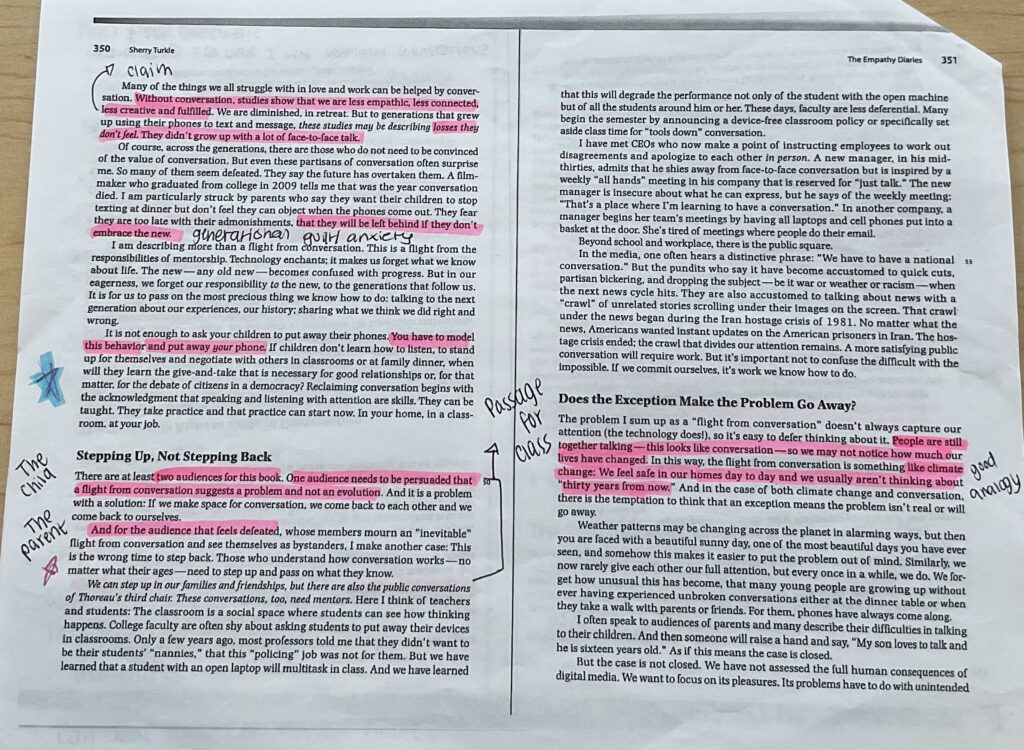
Framing Statement: ENG 110 has really challenged me to engage with the writing of others and practice active reading, critical reading, and informal reading to help enhance my own learning. When it comes to the process of annotation, I like to employ several different techniques. For one, as shown in the pictures provided below by the copious amount of pink highlighter, I find it helpful to simply highlight any sections or phrases within the text that draw my attention in anyway, shape, or form. I may have simply found what the author was saying was interesting, I may disagree with the statement, I am pointing out what I feel to be a claim or subclaim, or I think I’ve found a quote with good substance. In order to organize this mess of highlighter and specifically jot down my thoughts, you will see that marginal notes written in pen accompany a large number of these areas of pink highlighter. These marginal annotations tend to be very quick and informal, such as “exigence for piece,” “interesting!!,” “passage for class,” and “digital conversation inhibits empathy.” The informality of these annotations actually helps me stay engaged with the material, while also allowing me to continue through the piece with ease as I don’t lose my place in text and what the author was talking about. Many of these quick notes like, “phones too!! @ young ages,” “the child, the parent,” or “child perspective: tech as a safe haven,” would not make any sense to an outside set of eyes, however I know exactly what I mean. It is as if I have created a new little language with myself. One last aspect of this annotated article that I want to point out is the several blue-colored stars that are found on a few pages. These stars actually indicate passages that I selected to use within my Project #1 during a reread. I feel as though this highlights my ability to actively and critically read a text. I have continually been annotating this piece throughout the semester. I used this peice from Turkle in both Project #1 and Project #2. For each of these projects, I reread this text and added annotations, especially hunting for areas of the work that coincided nicely with each prompt. In addition to my annotations, I have included my responses to Journal #3 and Journal #5, discussion boards in which we were tasked to engage with “The Empathy Diaries” by Sherry Turkle. Journal #3 demonstrates my ability to critically read as I came up with two compelling questions that I still had after reading the text. I also selected a passage that I though would spark up interesting debate in an in-class discussion. In Journal #5, we were tasked with selecting two passages that stood out to us and explaining where we found it, why we chose it, and a connection we had to it. Within this journal, I found strong passages and connected them with my personal experiences being away at college and was able to denote that this essay had a hopeful tone that made it feel like a call to action piece.
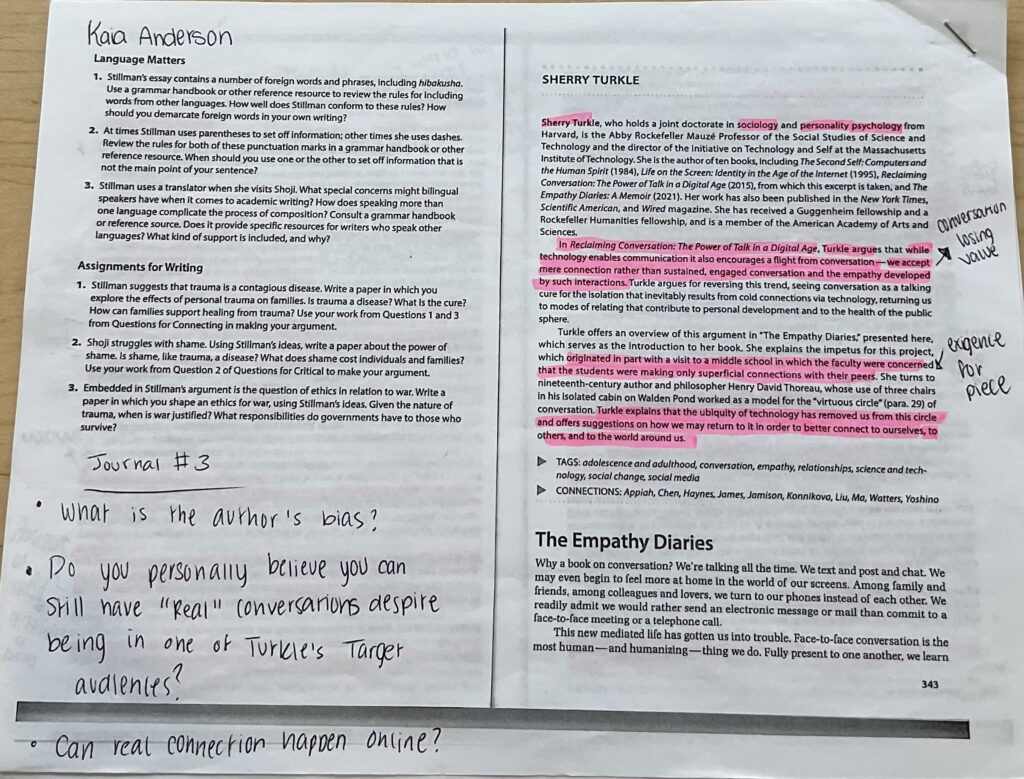
Journal #3:
1. Come to class with 2 questions you have about “The Empathy Diaries” that might help us start a class discussion
– What is the author’s bias?
– Do you personally believe you can have “real” conversations despite being in one of Turkle’s target audiences?
2. Identify 1 passage (something more than 3 sentences) from the text that you’d like to discuss in class.
“There are at least two audiences for this book. One audience needs to be persuaded that a flight from conversation suggests a problem and not an evolution. And it is a problem with a solution: If we make space for conversation, we come back to each other and we come back to ourselves. And for the audience that feels defeated, whose members mourn an “inevitable” flight from conversation and see themselves as bystanders, I make another case: This is the wrong time to step back” (350).
Journal #5:
Passage 1: “I’ve gone to a reunion of my six-grade class from PS 216 Brooklyn that could never have happened if not for Facebook. Texts from my daughter, when she was twenty-three, made her seem closer to home even when she took a job on another coast. These from fall 2014: ‘Hi! I REALL like Life After Life!’ ‘Where do I get challah?’ ‘My roommate and I are going to the party as Elsa and Anna from Frozen.’ All of a sudden, with no warning, on my phone, in my hand, there will be a reference to a book or food or a Halloween costume that reminds me of our intimacy and infuses my day with her presence.”
Locate: Page 348, the first paragraph of the “Crossroads” section, sentence 3
Why: I chose this passage as it adds to the complexity of the piece. This is one of the first times throughout the essay where Turkle acknowledges a counter argument and even relates to the importance of communication through technology in her own life. It’s interesting to me that Turkle explains her communication with her daughter over the phone as a reminder of their intimacy and connection, as opposed to the conversations themselves holding intimacy. I agree that a conversation over the phone lacks several aspects unique to in person communication, but I disagree in the sense that technological conversations are completely void of intimacy and connection.
Connection: Especially since I’ve been away at college, I have had to rely on communication via my phone to keep in touch with my family and friends. When I talk to my loved ones over the phone, I feel a real sense of connection and truly believe it doesn’t only stem from a reminder of our relationship. I believe the conversations themselves also hold intimacy.
Passage 2: “It is not enough to ask your children to put away their phones. “You have to model and put away your phone. If children don’t learn how to listen, how to stand up for themselves and negotiate with others in the classroom or at family dinner, when will they learn the give-and-take that is necessary for good relationships or, for that matter, for the debate of citizens in a democracy? Reclaiming conversation begins with the acknowledgement that speaking and listening with attention are skills. They can be taught. They take practice and that practice can start now.”
Locate: Page 350, paragraph 4
Why: This passage jumped out to me because I strongly agree with it. I can’t explain the number of times I’ve seen adults complain about phone use in younger generations, while they were naïve to their own phone use. It is crucial for parents and role models to set good examples of the behaviors they advocate for their children and other youth. Children act by example and are creatures of imitation. We can’t expect them to avoid a dependency on technology and learn the proper social skills to foster genuine relationships if they aren’t taught to do so.
Connection: This passage hints at greater themes that are reiterated constantly throughout the text. One theme is this idea of “the defeated,” the audience reading this essay who feels as though there is nothing that can be done about the current issues regarding a flight from conversation. Although it is not explicitly stated, I feel as though this group of people was who Turkle was speaking to in this passage, explaining that there is in fact something that can be done. The other theme that this passage highlights is that the effects of this flight from conversation are not irreversible. Through the continuous reiteration of this theme throughout the text, the tone is hopeful, and it becomes clear that the essay serves as a call to action piece.
